
Understanding Frequency-Based Wellness for Pets and Horses
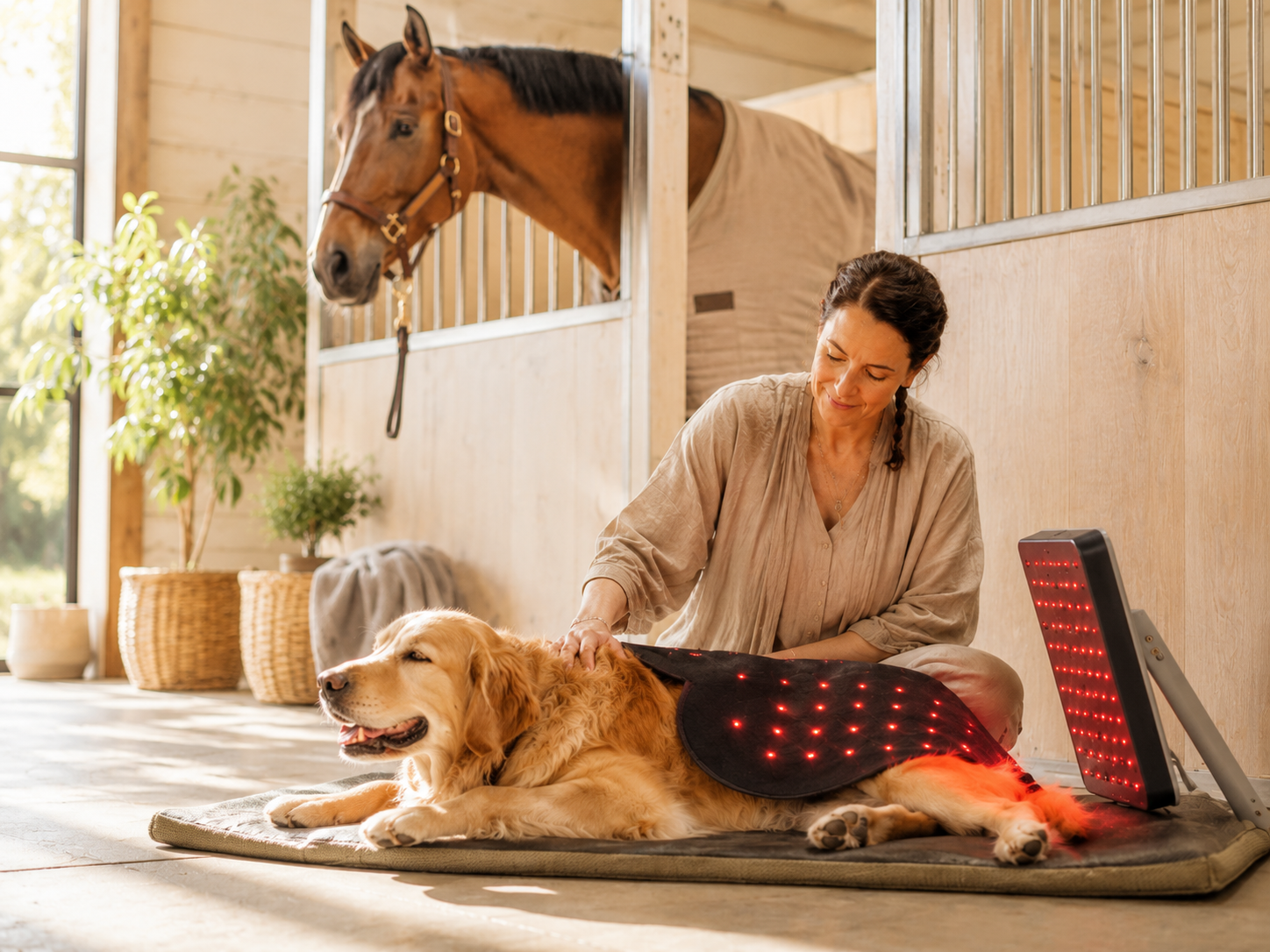
A relaxed golden retriever receives red light therapy beside a calm horse in a bright stable, illustrating frequency-based wellness support for pets and horses.
Understanding the role—and the limits—of supportive approaches used alongside veterinarian-led care.
Caring for an animal often continues long after the veterinary appointment ends.
At home, families are still observing, adjusting routines, and trying to understand what helps their companion feel secure, comfortable, and engaged. That may lead to quieter environments, more intentional habits, or interest in approaches such as Reiki, Bach flower formulas, red light, PEMF, or other wellness technologies.
There can be a place for these approaches, but only when their purpose is clear.
Complementary wellness is not veterinary medicine. It does not diagnose a condition, determine the cause of a change, prescribe a solution, or replace professional care. Its role is to exist alongside veterinarian-led care as part of a broader approach to everyday well-being.
Observation Before Intervention
Responsible complementary wellness begins with observation rather than intervention.
Before adding another product, session, or device, it helps to understand the animal’s normal behavior, daily rhythms, environment, and preferences.
Where does the animal choose to rest? Has their interest in familiar activities changed? Are they seeking more closeness, more distance, or a quieter place?
A single moment rarely tells the whole story. Patterns matter.
Observation does not replace veterinary evaluation. It helps families notice change and respond more thoughtfully.
Complementary Means “Alongside”
The words complementary and alternative are often used as though they mean the same thing. They do not.
An alternative is used instead of something else. A complementary approach is added around an existing plan without attempting to replace it.
That distinction protects the animal.
If a dog suddenly avoids stairs, a cat stops eating, or a horse reacts differently during work, the first question is not which modality to choose. It is whether the change requires veterinary attention.
Once medical needs have been evaluated, families may still want to support calm routines, emotional steadiness, rest, connection, or environmental comfort. That is where complementary wellness may fit.
Different Approaches, Different Evidence
Not every modality belongs in the same category, and they should not all be described in the same way.
Presence-based and relational practices, such as Reiki, center on quiet presence, low-demand interaction, and a calm setting. Their value should be described through the experience they may create—not as a way to identify, correct, or heal a medical problem.
Flower essence approaches, including Bach flower formulas, are used by some caregivers within emotional-wellness routines during travel, household changes, or other transitions. They should not be presented as substitutes for veterinary or qualified behavioral care.
Light and electromagnetic technologies, such as red light and PEMF, involve measurable forms of physical energy. They have been explored in veterinary and rehabilitation settings, but devices, intended uses, and levels of evidence vary.
Emerging frequency-based wellness technologies require additional caution. Broad terms such as balance, energy, or cellular support do not explain what a device delivers or what evidence supports its use.
Different modalities are supported by different types and levels of evidence. Some have been investigated more extensively than others, and research continues to evolve.
A responsible approach does not place every modality on equal footing.
The Caregiver Is Part of the System
Complementary wellness is not only about what is offered to an animal.
It also involves the caregiver’s ability to notice subtle changes, maintain consistent routines, reduce unnecessary stress, and respond thoughtfully over time.
Often, the most meaningful contribution comes not from adding another modality, but from becoming more attentive to the animal’s daily experience.
A predictable schedule, a quieter resting area, or a slower introduction to change may shape well-being more than any single product.
The caregiver’s role is not to interpret every change as a diagnosis. It is to observe and know when professional guidance is needed.
The Boundary That Protects the Animal
A responsible wellness provider should be comfortable saying:
“This needs veterinary attention.”
That sentence is not a limitation. It is a safeguard.
Concern is warranted when a service or product:
Promises healing, pain relief, or guaranteed improvement
Claims to identify a condition through energy, photographs, behavior, or device readings
Suggests changing medication or ignoring veterinary instructions
Discourages professional evaluation
A disclaimer cannot repair an exaggerated promise. The entire experience must respect the boundary between wellness support and veterinary care.
Better Questions Lead to Better Decisions
Before introducing a complementary approach, families can ask:
What are we hoping to support?
Has any new or unexplained change been evaluated?
Is the goal clearly nonmedical?
What does the modality or device actually involve?
How will we observe the animal’s comfort and response?
These questions move the conversation away from hype and toward the individual animal.
Thoughtful complementary wellness does not begin with a modality. It begins with observation, continues with informed choices, and always respects veterinary care.
Educational notice: This article is provided for educational purposes only. Complementary wellness modalities are not substitutes for veterinary examination, diagnosis, treatment, medication, or emergency care. Consult a licensed veterinarian regarding new symptoms, behavioral changes, diagnosed conditions, recent procedures, pregnancy, medication use, implanted electronic devices, or concerns about an animal’s health.
